
Industrial AI · Case study
AI-powered compressed air monitoring to help smaller manufacturers understand leaks, energy use and maintenance needs.
Explore the prototypeCompressed air keeps production moving. Leaks and inefficient operation can be difficult to spot without specialist monitoring. QuantAirSense explores a more accessible route for SME manufacturers: interpret operating signals and turn them into clear, actionable diagnostics.
Feasibility prototype
Requirements, architecture and AI models
Primary development and test data
The web demonstrator combines leak classification, confidence scores and plain-language explanations. Pressure, flow and power signals help explain why a warning appeared and what to inspect next.
The project evaluates Random Forest classification, short-horizon forecasting and SHAP-based explanations. The dashboard brings these outputs together with maintenance risk and energy-efficiency indicators.
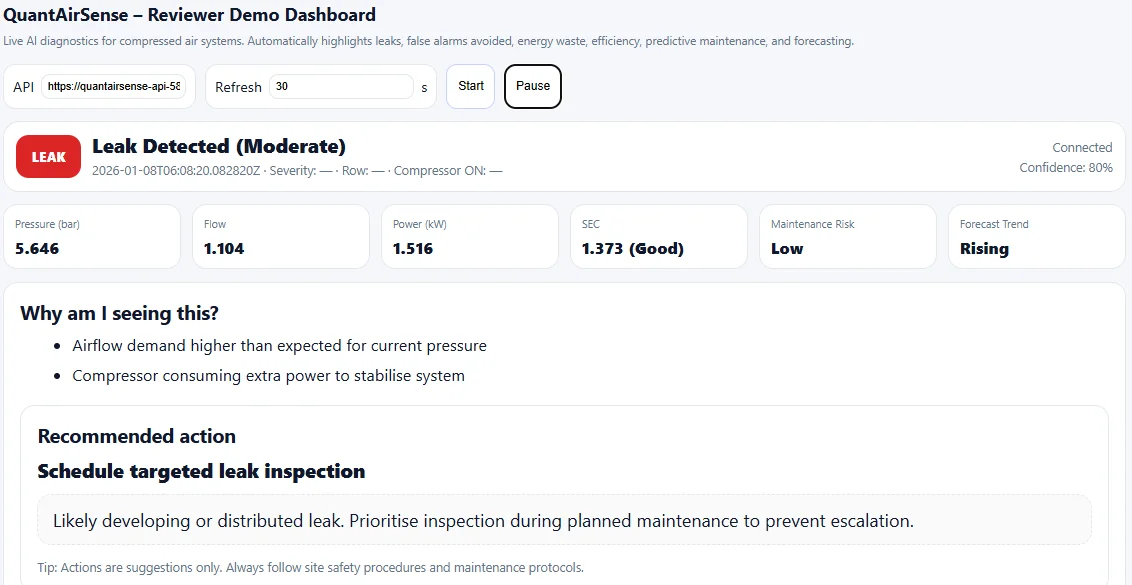
Prototype dashboard from the feasibility report. Shown with simulated operating data.
The architecture separates data handling from inference and the operator interface, making each layer easier to test and refine.
01
Import and validate time-series data. Use controlled simulations to explore normal operation and leak scenarios.
02
Prepare signals, derive features and classify conditions with trained machine learning models.
03
Estimate energy use, forecast short-term behaviour and explain which signals influenced a result.
04
Present system status, diagnostic context and recommended actions in a browser dashboard.
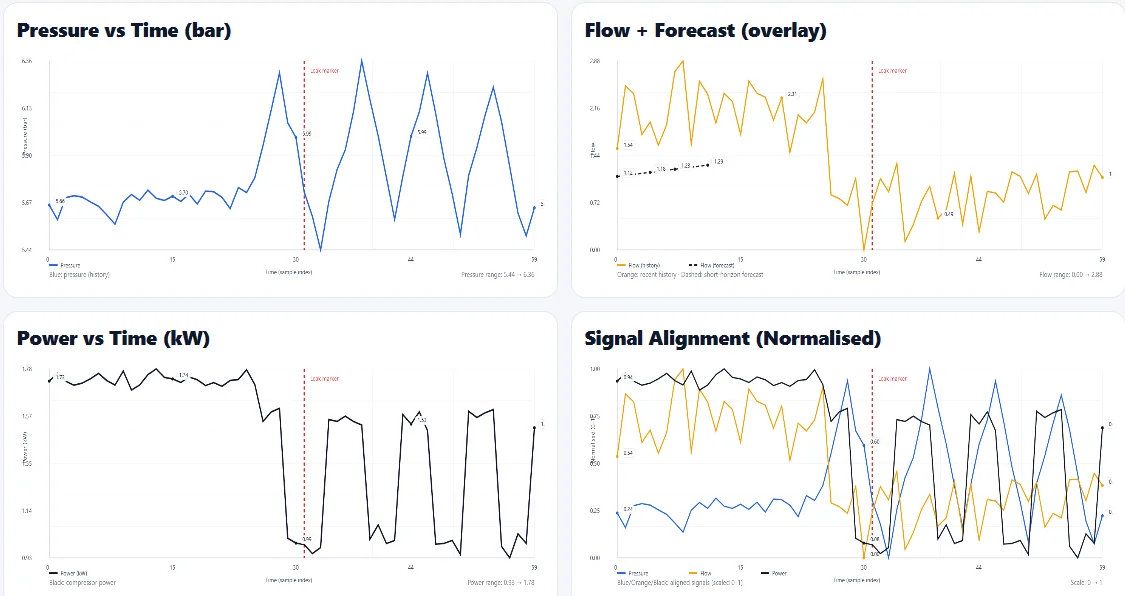
Pressure, flow, power and forecast views from a simulated leak scenario.
The January 2026 WP1/WP2 report documents a functional feasibility prototype, trained models and internal review. It reports 94.6% mean classification accuracy in five-fold cross-validation and 3.2% single-step forecasting MAPE on simulation data.
These are feasibility results, not measured factory savings. Progression towards TRL 5–6 requires operational SME data, labelled leak events and calibration against real equipment.